A phantom microstructure#
To test indexing we need a sample whose answer we know, and one that looks like the materials Anri is for. anri.phantom.polycrystal makes a 2D slice of a polycrystal with the features that make real maps hard:
grains with random orientations, from a Voronoi tessellation;
cells of about 1.5 µm inside them (dislocation or solidification cells), each turned from its grain by a few tenths of a degree;
annealing twins: lamellae with sharp boundaries, turned 60° about the grain’s ⟨111⟩ (the Σ3 twin of FCC metals).
Orientations are piecewise constant on a grid finer than the scan step, so one scan voxel can hold several cells, or a parent and its twin.
Here we make a 316L-like stainless steel phantom (FCC, a = 3.5966 Å), turn it into an ImageD11 TensorMap, look at it, and save it to tests/data, where the tests and the indexing tutorial use it.
This notebook is stored with its outputs and is not re-run when the docs are built.
[1]:
import anri.utils

anri.utils.setup()  # before any JAX computation

import numpy as np
from matplotlib import pyplot as plt

import anri.crystal
import anri.io
import anri.phantom
The microstructure#
A disk of radius 25 µm on a grid of 0.5 µm voxels (103 × 103), with 40 grains, cells of about 1.5 µm misoriented by 0.3° (standard deviation of each component of the rotation vector), and twin lamellae 2 µm thick every 5 µm in the largest grain.
[2]:
ph = anri.phantom.polycrystal(n=103, step=0.5, radius=25.0, n_grains=40, cell_size=1.5, cell_spread_deg=0.3,
                              twin_grains=1, twin_axis=(1, 1, 1), twin_angle_deg=60.0, twin_period=5.0,
                              twin_thickness=2.0, seed=0)
inside = ph["inside"]
print(f"{inside.sum()} voxels in the disk, {len(np.unique(ph['grain'][inside]))} grains, "
      f"{len(np.unique(ph['cell'][inside]))} cells, {ph['twin'].sum()} twin voxels")
7845 voxels in the disk, 38 grains, 721 cells, 253 twin voxels
Symmetry and misorientations#
anri.crystal.laue_rotations gives the 24 proper rotations of the cubic Laue group, as Cartesian matrices in the crystal frame: U and U S give the same reflections. Misorientations are taken over them with anri.crystal.disorientation.
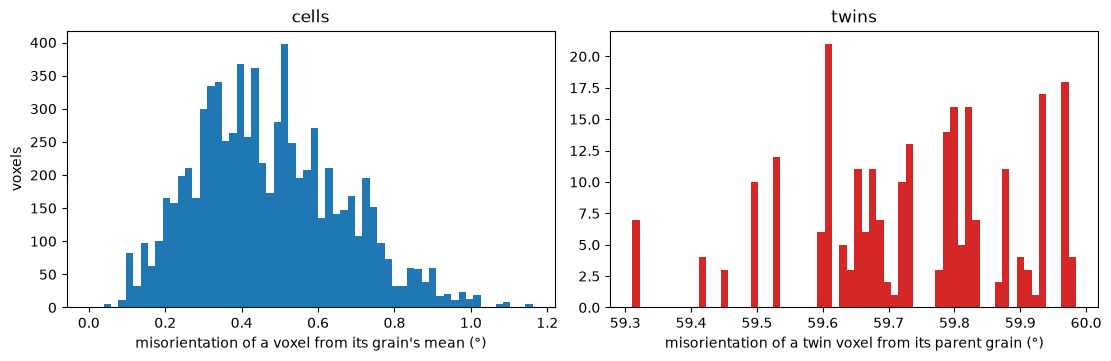
Each cell is a small rotation away from its grain, and each twin is 60° away from its parent: let’s check.
[3]:
a = 3.5966
B = anri.crystal.B_matrix([a, a, a, 90.0, 90.0, 90.0])
ops = anri.crystal.laue_rotations(anri.crystal.symmetry_matrices(225), B)
print(f"{len(ops)} Laue-group rotations")

U = ph["U"].reshape(-1, 3, 3)
grain, twin = ph["grain"].ravel(), ph["twin"].ravel()
# each grain's mean orientation, from its non-twin voxels (cells are within a degree, so a plain mean works)
mean_U = {}
for g in np.unique(grain[grain >= 0]):
    u, _, vt = np.linalg.svd(U[(grain == g) & ~twin].mean(0))
    mean_U[g] = u @ vt
mis = np.full(len(U), np.nan)
ins = inside.ravel()
mis[ins] = anri.crystal.disorientation(U[ins], np.stack([mean_U[g] for g in grain[ins]]), ops)

fig, ax = plt.subplots(1, 2, figsize=(11, 3.5), layout="constrained")
ax[0].hist(mis[ins & ~twin], bins=60, color="tab:blue")
ax[0].set_xlabel("misorientation of a voxel from its grain's mean (°)")
ax[0].set_ylabel("voxels")
ax[0].set_title("cells")
ax[1].hist(mis[twin], bins=60, color="tab:red")
ax[1].set_xlabel("misorientation of a twin voxel from its parent grain (°)")
ax[1].set_title("twins")
plt.show()
24 Laue-group rotations
As a TensorMap#
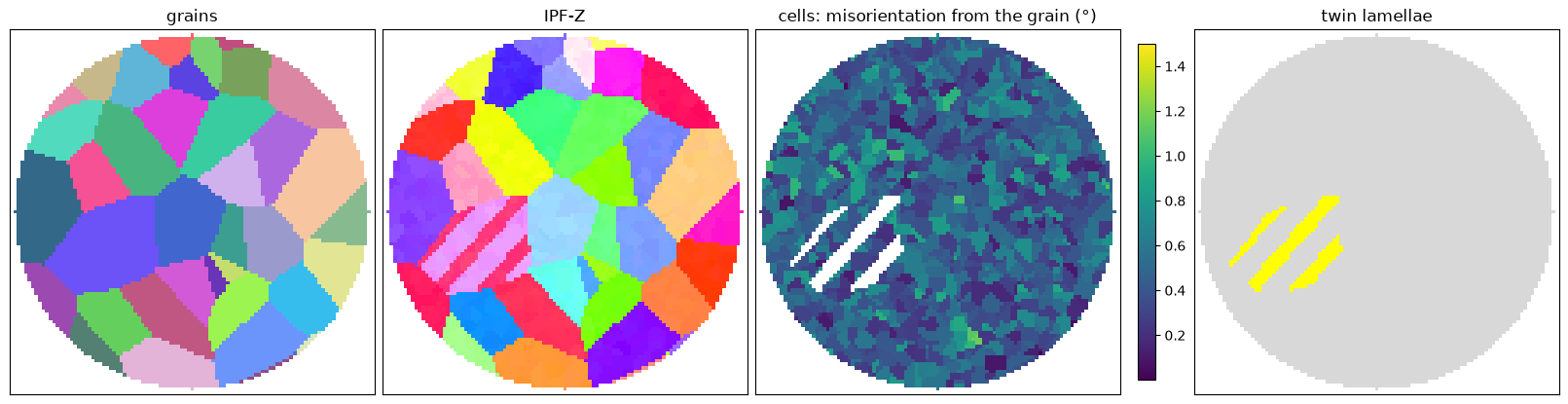
anri.io.tensormap_from_recon takes maps in reconstruction order and builds an ImageD11 TensorMap, so the phantom can be viewed and used like any map ImageD11 makes. Next to the UBI and the phase, we store the grain (labels), cell and twin maps.
[4]:
UBI = np.where(inside[..., None, None], np.linalg.inv(ph["U"] @ B), np.nan)
maps = {"UBI": UBI, "phase_ids": np.where(inside, 0, -1), "labels": ph["grain"], "cell": ph["cell"],
        "twin": ph["twin"].astype(np.int8), "misorientation": mis.reshape(inside.shape)}
tmap = anri.io.tensormap_from_recon(maps, [a, a, a, 90.0, 90.0, 90.0], 225, "316L", 0.5)
for name in ("B", "U", "UB", "mt", "unitcell", "euler"):
    getattr(tmap, name)  # ImageD11's derived maps, computed from UBI and kept in the maps
tmap.get_ipf_maps()
print(tmap.shape, tmap.steps, tmap.phases)
(1, 103, 103) [0.5, 0.5, 0.5] {0: 316L | [ 3.5966 3.5966 3.5966 90. 90. 90. ] | 225}
[5]:
rng = np.random.default_rng(1)
colours = rng.uniform(0.2, 1.0, (tmap.labels.max() + 1, 3))
labels = tmap.labels[0]
grain_rgb = np.where(labels[..., None] >= 0, colours[np.maximum(labels, 0)], 1.0)

fig, ax = plt.subplots(1, 4, figsize=(16, 4.4), layout="constrained")
ax[0].imshow(grain_rgb, origin="lower")
ax[0].set_title("grains")
ax[1].imshow(np.where(labels[..., None] >= 0, tmap.ipf_z[0], 1.0), origin="lower")
ax[1].set_title("IPF-Z")
im = ax[2].imshow(np.where(tmap.twin[0] == 1, np.nan, tmap.misorientation[0]), origin="lower", cmap="viridis", vmax=1.5)
ax[2].set_title("cells: misorientation from the grain (°)")
fig.colorbar(im, ax=ax[2], shrink=0.8)
ax[3].imshow(np.where(labels[..., None] >= 0, 0.85, 1.0) * np.ones(3), origin="lower")
ax[3].imshow(np.ma.masked_where(tmap.twin[0] == 0, tmap.twin[0]), origin="lower", cmap="autumn", vmin=0, vmax=1)
ax[3].set_title("twin lamellae")
for a_ in ax:
    a_.set_xticks([]), a_.set_yticks([])
plt.show()
Save it#
The phantom is saved where the tests and the other notebooks find it.
[6]:
import os

out = os.path.join("..", "..", "..", "tests", "data", "phantoms", "am316l", "am316l_tmap.h5")
if os.path.exists(out):
    os.remove(out)
tmap.to_h5(out)
print(f"{out}: {os.path.getsize(out) / 1e6:.1f} MB")
../../../tests/data/phantoms/am316l/am316l_tmap.h5: 1.0 MB